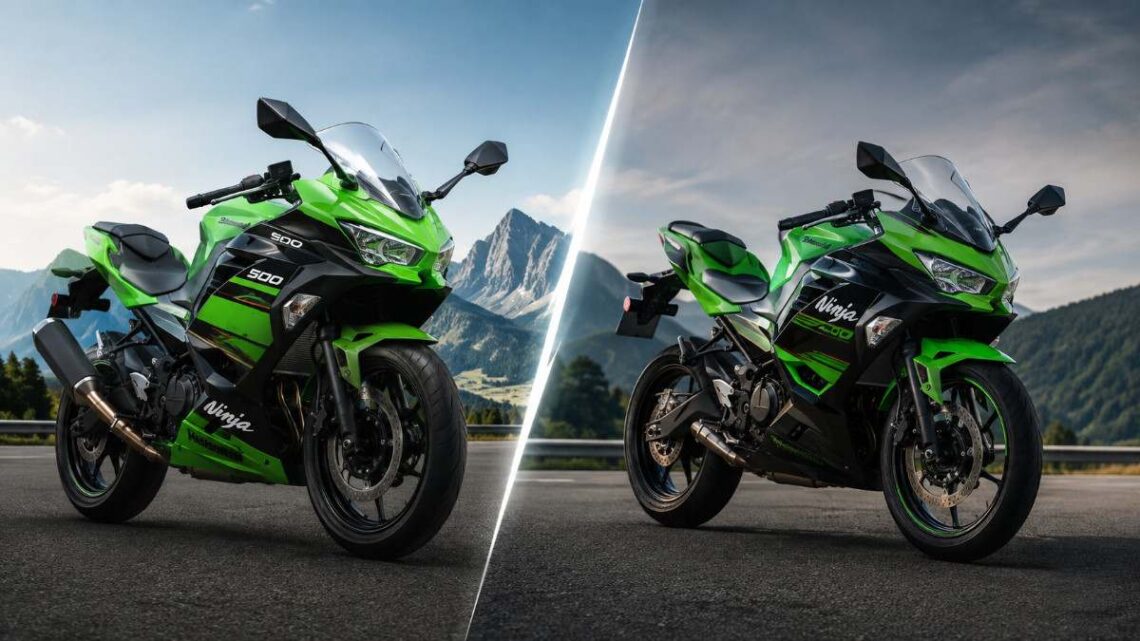
Kawasaki Ninja 500 vs Ninja 400: Complete Comparison (2026 Guide)
If you are planning to buy your first sport bike, there is a good chance you have looked at the Kawasaki Ninja 500 and the Kawasaki Ninja 400. Both motorcycles are known for their sporty styling, smooth engines, and beginner-friendly performance. At first glance, they look very similar, but there are several important differences that can help you decide which one fits your riding style.
The Ninja 400 became one of the most popular beginner motorcycles in the world because it offered a perfect balance of power, comfort, and affordability. Kawasaki later introduced the Ninja 500, which builds on that success with a larger engine, updated styling, and more torque for everyday riding.
So, is the newer Ninja 500 worth the extra money? Or is the Ninja 400 still the smarter buy?
In this detailed comparison, we’ll compare both motorcycles in terms of engine performance, design, comfort, technology, fuel economy, pricing, maintenance costs, and overall value.
Kawasaki Ninja 500 vs Ninja 400: Quick Comparison
| Feature | Kawasaki Ninja 500 | Kawasaki Ninja 400 |
|---|---|---|
| Engine | 451cc Parallel Twin | 399cc Parallel Twin |
| Maximum Power | 51 hp | 45 hp |
| Maximum Torque | 42.6 Nm | 37 Nm |
| Transmission | 6-Speed | 6-Speed |
| Seat Height | 785 mm | 785 mm |
| Wet Weight | Around 172 kg | Around 168 kg |
| Fuel Tank | 14 Liters | 14 Liters |
| ABS Available | Yes | Yes |
| Best For | New Riders & Daily Use | Beginners & Budget Buyers |
Overview
Although the Ninja 500 replaced the Ninja 400 in many markets, the two bikes are much more alike than different.
The Ninja 500 uses an updated version of the Ninja 400’s engine. Kawasaki increased the engine capacity from 399cc to 451cc while keeping the motorcycle lightweight and beginner-friendly.
The result is a motorcycle that feels more relaxed during city rides and highway cruising without becoming difficult to ride.
If you have never owned a sport bike before, either motorcycle can be an excellent choice.
Engine and Performance
Kawasaki Ninja 500
The Ninja 500 is powered by a 451cc liquid-cooled parallel-twin engine.
It produces approximately:
- 51 horsepower
- 42.6 Nm torque
While these numbers may not look dramatically higher than the Ninja 400, the biggest improvement is the extra torque.
You feel stronger acceleration at lower RPMs.
That means:
- Less gear shifting
- Easier overtaking
- Better city riding
- Smoother highway cruising
For beginners, this makes riding more enjoyable because the motorcycle feels powerful without being intimidating.
Kawasaki Ninja 400
The Ninja 400 comes with a 399cc parallel-twin engine producing around:
- 45 horsepower
- 37 Nm torque
The engine is smooth, reliable, and loves higher RPMs.
Many riders still consider it one of the best beginner motorcycle engines ever built.
Acceleration is quick enough for city riding, weekend trips, and highway travel.
However, compared with the Ninja 500, it requires slightly more throttle and higher RPMs to deliver its best performance.
Which Engine Feels Better?
If you ride mostly inside the city, you will immediately notice the Ninja 500’s stronger low-end torque.
You don’t need to work the gearbox as often.
The Ninja 400 still feels sporty, but it likes to rev higher before delivering maximum power.
For experienced riders, the difference isn’t huge.
For beginners, the Ninja 500 simply feels easier to ride.
Winner: 🏆 Ninja 500
Acceleration
Although neither motorcycle is designed to be a superbike, both are surprisingly quick.
Ninja 500
Estimated 0–60 mph:
Around 4.3 seconds
Ninja 400
Estimated 0–60 mph:
Around 4.5–4.7 seconds
The difference isn’t massive.
Both bikes are faster than most cars on the road.
For everyday riding, either motorcycle offers plenty of performance.
Top Speed
Ninja 500
Approximate top speed:
115–120 mph (185–193 km/h
Ninja 400
Approximate top speed:
110–116 mph (177–187 km/h)
Again, the difference is relatively small.
Most riders will never reach these speeds on public roads.
The Ninja 500 simply has a little more power for overtaking and highway riding.
Fuel Economy
Fuel efficiency is one reason these motorcycles are so popular.
Ninja 500
Average fuel economy:
Approximately 60 mpg (US)
Ninja 400
Average fuel economy:
Approximately 63–65 mpg (US)
The Ninja 400 is slightly more fuel-efficient because of its smaller engine.
However, the difference is small enough that most riders won’t notice much extra fuel cost with the Ninja 500.
Ride Quality
Both motorcycles are comfortable for everyday riding.
The riding position isn’t extremely aggressive like a supersport motorcycle.
Instead, Kawasaki designed them to be sporty while remaining comfortable for commuting.
Ninja 500
The extra torque means fewer gear changes.
The engine feels smoother at lower RPMs.
Highway rides are more relaxed because the bike doesn’t need to work as hard.
Ninja 400
The Ninja 400 also provides a comfortable ride.
Its lighter weight makes it feel slightly more agile in traffic.
The steering feels light, making it easy for beginners to build confidence.
Suspension
Both motorcycles feature:
- Telescopic front forks
- Rear mono-shock suspension
The suspension setup is tuned more for street riding than racing.
It handles:
- Daily commuting
- Weekend rides
- Twisty roads
- Light touring
Very well.
Neither bike is intended for serious off-road riding.
Braking Performance
Safety is one of Kawasaki’s strengths.
Both motorcycles come with strong disc brakes.
ABS models provide extra confidence during emergency braking, especially on wet roads.
The brakes offer:
- Good stopping power
- Smooth brake feel
- Beginner-friendly control
There isn’t a major difference between the two motorcycles in braking performance.
Handling
One reason riders love the Ninja series is the handling.
Both bikes feel:
- Light
- Predictable
- Easy to corner
- Stable at highway speeds
The Ninja 400 has a slight advantage because it weighs a few kilograms less.
The Ninja 500, however, makes up for that with stronger acceleration coming out of corners.
For most riders, both motorcycles feel equally enjoyable.
Part 1 Summary
So far, the Kawasaki Ninja 500 has a slight edge thanks to its larger engine, stronger low-end torque, and smoother highway performance. The Ninja 400 remains an excellent option for riders who want a lighter, fuel-efficient, and budget-friendly sport bike with proven reliability.
Kawasaki Ninja 500 vs Ninja 400: Design, Features, Price & Final Verdict (Part 2)
Design and Styling
At first glance, the Kawasaki Ninja 500 and Ninja 400 look almost identical. Kawasaki didn’t completely redesign the bike when introducing the Ninja 500. Instead, it refined the successful Ninja 400 platform with subtle styling updates and modern features.
Both motorcycles feature:
- Sharp twin LED headlights
- Full aerodynamic fairings
- Aggressive fuel tank design
- Sporty riding position
- Split-seat styling
The Ninja 500 receives updated graphics and fresh color options depending on the market, giving it a slightly more premium appearance. Some versions also include a color TFT display with smartphone connectivity, adding a more modern feel than the Ninja 400’s simpler instrument cluster.
Winner: Ninja 500
Build Quality
Kawasaki has a strong reputation for producing motorcycles with excellent build quality, and both models live up to that standard.
You’ll notice:
- High-quality paint
- Strong plastics
- Smooth switchgear
- Comfortable seat materials
- Excellent overall fit and finish
Even after years of daily riding, many Ninja 400 owners report that their bikes continue to feel solid with proper maintenance.
The Ninja 500 maintains the same high standards while adding a few modern touches.
Instrument Cluster
Ninja 500
Depending on the trim and market, the Ninja 500 may include:
- Full-color TFT display
- Bluetooth smartphone connectivity
- Ride information
- Fuel economy display
- Gear position indicator
- Call and notification support through Kawasaki’s Rideology app
Ninja 400
The Ninja 400 uses a simple LCD display with:
- Speedometer
- Tachometer
- Gear indicator
- Fuel gauge
- Trip meter
It is easy to read but lacks modern connectivity features.
Winner: Ninja 500
Comfort for Daily Riding
Many people assume sport bikes are uncomfortable.
Fortunately, these two motorcycles are much friendlier than supersport machines.
Both offer:
- Upright handlebars
- Comfortable seat height
- Relaxed footpeg position
- Good visibility
With a 785 mm seat height, both bikes are accessible to a wide range of riders.
The Ninja 500 feels slightly more relaxed on highways because of its stronger mid-range torque, while the Ninja 400 feels lighter during city riding.
Highway Performance
If you regularly travel on highways, the Ninja 500 is the better choice.
The larger 451cc engine provides:
- Stronger overtaking performance
- Lower engine stress at cruising speeds
- Better acceleration with a passenger
- Less frequent gear changes
The Ninja 400 still performs well on highways, but it needs higher RPMs to deliver its best performance.
City Riding
In city traffic, both bikes are enjoyable.
Ninja 400 Advantages
- Slightly lighter weight
- Easy steering
- Smooth clutch
- Great for beginners
Ninja 500 Advantages
- More torque
- Easier acceleration
- Fewer gear changes
- Better low-speed flexibility
Both motorcycles are excellent commuters.
Technology and Safety
Both motorcycles include:
- LED headlights
- LED tail lights
- Slipper and assist clutch
- Fuel injection
- ABS (on ABS models)
- Digital instrument panel
The Ninja 500 gains an advantage with optional TFT instrumentation and smartphone connectivity in certain versions.
Maintenance Cost
One of the biggest reasons riders choose Kawasaki is reliability.
Routine maintenance includes:
- Engine oil changes
- Oil filter replacement
- Air filter cleaning
- Chain lubrication
- Brake inspection
- Coolant replacement
- Valve inspection at recommended intervals
Since the Ninja 500 is based on the Ninja 400 platform, maintenance costs are very similar.
Reliability
The Ninja 400 has earned an outstanding reputation over the years.
Owners frequently report:
- Reliable engine
- Smooth gearbox
- Low maintenance
- Long engine life
The Ninja 500 builds on the same platform with a larger engine, so expectations for reliability remain high when serviced according to Kawasaki’s schedule.
Price and Value
The biggest deciding factor is often price.
Buy the Ninja 400 if:
- You find a clean used model.
- You want to save money.
- You’re buying your first motorcycle.
- You don’t mind missing a few newer features.
Buy the Ninja 500 if:
- You want a brand-new motorcycle.
- You prefer updated technology.
- You ride on highways frequently.
- You plan to keep the bike for several years.
Pros and Cons
Kawasaki Ninja 500
Pros
- More powerful 451cc engine
- Stronger low-end torque
- Better highway performance
- Modern TFT display (select models)
- Updated styling
- Excellent beginner motorcycle
Cons
- Costs more than a used Ninja 400
- Slightly heavier
- Fuel economy is marginally lower
Kawasaki Ninja 400
Pros
- Excellent value
- Proven reliability
- Lightweight handling
- Outstanding fuel economy
- Ideal first sport bike
Cons
- Older dashboard
- Less torque
- Mostly available used in markets where it has been replaced
Kawasaki Ninja 500 vs Ninja 400: Which One Should You Buy?
Choose the Ninja 500 if:
- You want the latest model.
- You value stronger acceleration.
- You ride on highways often.
- You like modern technology and connectivity.
Choose the Ninja 400 if:
- You have a limited budget.
- You want one of the best beginner motorcycles ever built.
- You find a well-maintained used bike at a good price.
- You mainly ride in the city.
Final Verdict
The Kawasaki Ninja 500 is the better motorcycle overall. It keeps everything riders loved about the Ninja 400 while adding a larger 451cc engine, improved torque, and more modern technology. The changes are not dramatic, but they make the bike feel smoother and more capable for everyday riding.
That said, the Ninja 400 is still an outstanding choice. If you can find one in excellent condition, it remains one of the best-value beginner sport bikes on the market. Its lightweight handling, reliable engine, and affordable ownership costs make it an easy recommendation.
If you’re buying new, the Ninja 500 is the clear winner.
If you’re shopping used and want to save money, the Ninja 400 delivers exceptional value.
Frequently Asked Questions (FAQs)
Is the Kawasaki Ninja 500 faster than the Ninja 400?
Yes. The Ninja 500 produces more power and torque, giving it quicker acceleration and slightly higher top-end performance.
Is the Ninja 500 good for beginners?
Absolutely. Despite the larger engine, it remains smooth, predictable, and easy to ride, making it an excellent beginner-friendly sport bike.
Is the Ninja 400 discontinued?
In several markets, Kawasaki has replaced the Ninja 400 with the Ninja 500, although availability varies by region.
Which bike is better for daily commuting?
Both are excellent commuters. The Ninja 400 is lighter and very fuel efficient, while the Ninja 500 offers stronger low-speed torque and more relaxed highway cruising.
Which motorcycle offers better value?
A well-priced used Ninja 400 is hard to beat for value. However, if you want the latest features and plan to keep the bike for years, the Ninja 500 is worth the extra investment.


You May Also Like
Royal Enfield Hunter 350 vs TVS Ronin: Which Retro-Modern Roadster Should You Buy?
Yamaha R15 V4 Review (2026): Is It Still the Best 155cc Sports Bike?