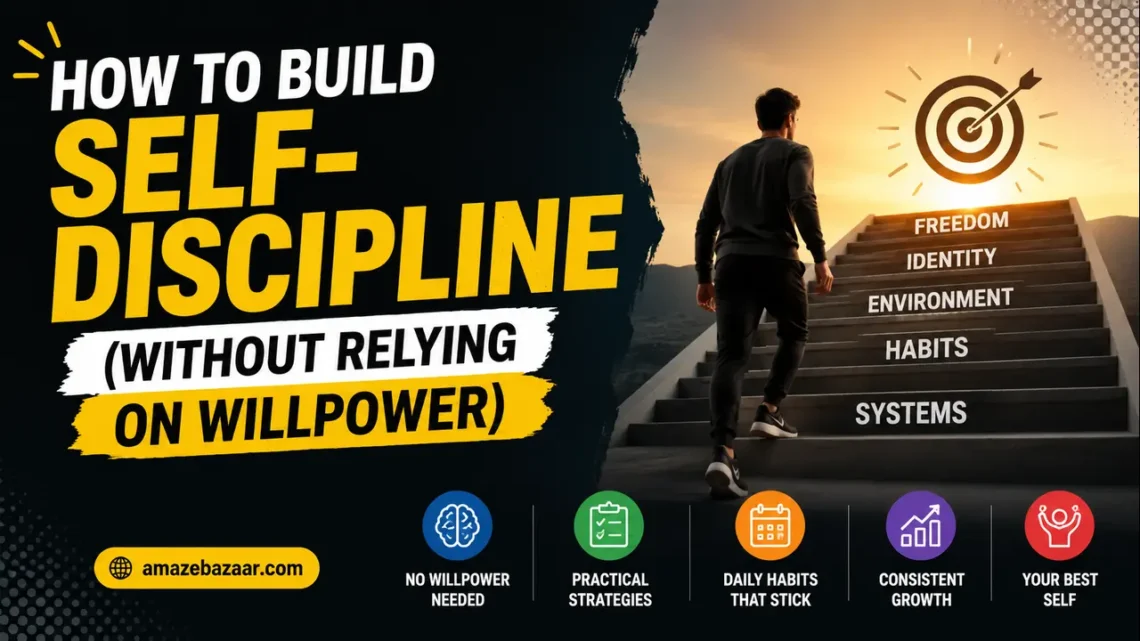
How to Build Self-Discipline (Without Relying on Willpower)
Most people think self-discipline is something you either have or you don’t. Like it’s a trait some lucky people were born with, and the rest of us are just stuck making excuses.
That’s not true, and honestly, it’s a little unfair to yourself if you’ve believed it.
Self-discipline isn’t about gritting your teeth and powering through on raw willpower. Willpower is a limited resource — it runs out by the end of a long day, which is exactly why your evening resolve to “eat healthy” or “not scroll before bed” tends to collapse. Real discipline is built through systems, not force. Here’s how.
Why Willpower Alone Doesn’t Work
Willpower behaves a bit like a muscle that fatigues with use. Every decision you make throughout the day — what to wear, how to respond to an email, whether to snap at someone in traffic — draws from the same limited pool. By evening, that pool is often close to empty, which is why healthy intentions tend to fall apart at night.
This is actually good news. It means your lack of discipline probably isn’t a character flaw. It’s a design problem. Fix the design, and the discipline follows.
1. Reduce the Number of Decisions You Have to Make
Every choice you eliminate in advance is a choice you don’t have to fight yourself over later. People who seem highly disciplined usually aren’t more willful than you — they’ve just automated more of their day.
Lay out your gym clothes the night before. Decide what you’re eating for breakfast on Sunday for the whole week. Set a fixed time to check email instead of reacting to it all day.
Try this: Pick one daily decision you can pre-make tonight, so tomorrow-you doesn’t have to negotiate with yourself.
2. Make the Right Action the Easy Action
Discipline gets a lot easier when the disciplined choice requires less effort than the undisciplined one. If your phone is on the nightstand, you’ll check it before sleep. If the junk food is in the pantry at eye level, you’ll eat it.
You’re not weak for giving in to friction — everyone does. The fix isn’t more resolve. It’s rearranging your environment so the good habit is the path of least resistance.
Try this: Pick one bad habit and add one extra step between you and it — move the app off your home screen, put the snacks on a high shelf, unplug the TV after use.
3. Use a Two-Minute Starting Rule
The hardest part of any disciplined action isn’t finishing it — it’s starting. So stop committing to the full task and commit only to the first two minutes.
Not “write for an hour.” Just open the document and write one sentence. Not “work out for 45 minutes.” Just put on your shoes. Once you’re moving, momentum tends to carry you further than you expected.
Try this: Next time you’re avoiding something, agree to do it for two minutes only. You can always stop after that.
4. Track the Action, Not the Outcome
Outcomes are slow and often outside your control. Discipline is built by focusing on the behavior you can control today, not the result you’re hoping to see in three months.
Instead of “lose 10 pounds,” track “did I move my body today, yes or no.” Instead of “get a promotion,” track “did I do one focused hour of deep work today.” A simple checkmark on a calendar, done consistently, builds discipline far more reliably than an ambitious goal you check on once a month.
Try this: Choose one habit this week and track only whether you did it — not how well, not how much.
5. Expect to Slip — Just Don’t Let It Become the Pattern
Disciplined people are not the ones who never fail. They’re the ones who don’t let one missed day spiral into a week off. There’s a real difference between missing once and quitting.
If you skip your habit today, the goal isn’t perfection tomorrow — it’s just showing up again. That’s it. That’s the whole recovery plan.
Try this: If you break the streak, don’t wait for Monday or the 1st of the month. Restart the very next chance you get, even if it’s tonight.
Discipline Is a Skill, Not a Personality Trait
The people who seem effortlessly disciplined aren’t fighting themselves less than you are — they’ve just spent longer building systems that don’t require a fight in the first place. Every one of them started exactly where you are now.
You don’t need to overhaul your entire life this week. Pick one of the five ideas above. Build it into something automatic. Then add the next one.
That’s genuinely the whole method.
Frequently Asked Questions
Is self-discipline something you’re born with? No — most research on habits and behavior points to discipline being learned through repeated practice and environment design, not something fixed at birth.
How long does it take to become more disciplined? It depends on the habit and the person, but consistent small actions tend to feel automatic somewhere between a few weeks and a few months. The size of the habit matters more than the exact timeline.
What’s the fastest way to build discipline? Reducing friction around good habits — and adding friction around bad ones — tends to work faster than relying on motivation or willpower alone, since it removes the need to constantly fight yourself.
Pick one habit from this list. Not all five. Just one — and give it two weeks before judging whether it’s working.

You May Also Like

Daily Habits That Change Your Life (Even If You Only Do One)

বাড়িতে একা বসেই Spoken English Practice করার সেরা উপায়