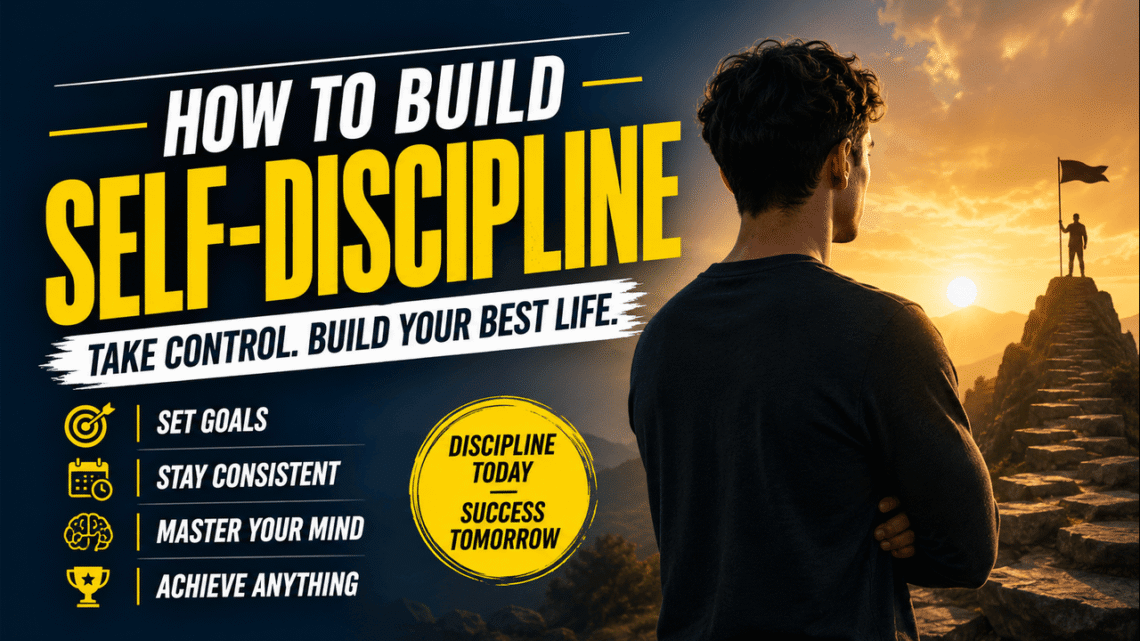
How to Build Self-Discipline (Even If You’ve Failed at It Before)
Let’s be honest about something first: if you’ve typed “how to build self-discipline” into Google, you’ve probably already tried the usual advice. Wake up at 5 a.m. Make your bed. Read a chapter every night. Cut sugar cold turkey. And somewhere around day four, it all fell apart, and you told yourself you just don’t have what it takes.
You do. You’ve just been building discipline the wrong way.
Self-discipline isn’t a personality trait some people are born with and others aren’t. It’s closer to a skill — like typing or cooking — that gets stronger with the right kind of practice and weaker when you rely on hype instead of habit. This guide walks through what actually works, based on how motivation, willpower, and behavior change really function, not how they’re marketed on social media.
Why Willpower Alone Doesn’t Work
Here’s the uncomfortable truth: willpower is a limited resource. Psychologists call this “ego depletion” — the idea that every decision you make throughout the day draws from the same mental battery. By the time you get home from work, resist the urge to check your phone forty times, and talk yourself out of ordering takeout, there’s often nothing left for the workout or the writing project you promised yourself you’d get to.
This is why “just try harder” advice fails so often. It’s not that you’re weak. It’s that you’re fighting a battle on willpower alone, and willpower runs out.
The people who seem effortlessly disciplined aren’t relying on raw willpower any more than you are. They’ve just restructured their environment and habits so that discipline requires less energy to maintain.
Start With Identity, Not Goals
One of the most overlooked shifts in building discipline is moving the target from “what I want to achieve” to “who I want to become.”
Saying “I want to lose 20 pounds” gives you a finish line, but no direction for the boring Tuesday afternoons in between. Saying “I’m becoming someone who takes care of their body” gives you a filter for every decision — including the ones with no deadline attached.
Try this: instead of writing down a goal, write down the identity behind it.
- Instead of “I want to write a book,” try “I’m a person who writes daily.”
- Instead of “I want to save money,” try “I’m someone who spends intentionally.”
- Instead of “I want to get fit,” try “I’m someone who shows up for my body.”
Every time you complete a small action tied to that identity, you’re casting a vote for the person you’re trying to become. Discipline gets easier when it’s no longer about forcing yourself to do something — it’s about being consistent with who you already believe you are.
Make the First Step Absurdly Small
Most discipline plans fail because they start too big. You don’t need a two-hour gym routine on day one. You need a habit that survives your worst days — the days you’re exhausted, unmotivated, and running on four hours of sleep.
This is where the “two-minute rule” comes in handy. Whatever habit you’re trying to build, shrink it down to something that takes two minutes or less:
- “Exercise for an hour” becomes “put on your workout clothes.”
- “Write a chapter” becomes “open the document and write one sentence.”
- “Read for 30 minutes” becomes “read one page.”
This isn’t a trick to lower your standards. It’s a strategy to lower the barrier to starting, because starting is almost always the hardest part. Once you’re standing in your workout clothes, going for a walk feels natural. Once you’ve written one sentence, the next ten come easier. Momentum, not motivation, is what carries most disciplined people through.
Design Your Environment So Discipline Isn’t a Daily Fight
If you’re relying on motivation to resist temptation every single day, you’re setting yourself up for burnout. The most disciplined people you know have usually just made bad choices harder to access and good choices easier to reach.
A few practical examples:
- Want to stop doomscrolling before bed? Charge your phone in another room.
- Want to eat healthier? Don’t keep junk food in the house — not as a moral failing, just logistics.
- Want to write every morning? Leave your laptop open to the document the night before.
- Want to stop hitting snooze? Put your alarm across the room, not on your nightstand.
None of these require extra willpower. They simply remove the moment of decision where discipline usually breaks down. If the disciplined choice is the path of least resistance, you’ll take it more often — even on low-energy days.
Track Progress, Not Perfection
A single missed day derails most people’s discipline — not because the missed day itself matters, but because of what they tell themselves afterward. “I already messed up, so what’s the point” is one of the most common reasons habits die.
This is where a simple tracking method helps more than most people expect. Something as basic as marking an X on a calendar for every day you complete your habit creates a visual streak you naturally don’t want to break. But the real value isn’t the streak — it’s what happens when you inevitably miss a day.
The rule that separates people who stick with habits long-term from people who quit isn’t “never miss a day.” It’s “never miss twice.” One missed day is life happening. Two in a row is the start of a new pattern — and that’s the moment to catch yourself.
Reframe Discomfort as Information, Not a Stop Sign
Discipline often gets confused with suffering, but the goal was never to feel miserable all the time. Discomfort is simply what change feels like before it becomes normal. The version of you that finds waking up early effortless didn’t start out that way — they just kept showing up long enough for it to stop feeling hard.
When you notice resistance to a habit, instead of asking “how do I force myself through this,” try asking:
- Is this discomfort telling me the habit is genuinely wrong for me, or just unfamiliar?
- Am I trying to change too many things at once?
- Is my goal realistic for the season of life I’m actually in?
Sometimes discomfort is a signal to push through. Sometimes it’s a signal to adjust the plan. Learning to tell the difference is part of building real, sustainable discipline — not the all-or-nothing version that burns people out in three weeks.
Build in Recovery, Not Just Routine
Ironically, one of the most disciplined things you can do is rest on purpose. People who never build recovery into their routine tend to burn out and abandon the habit entirely, while people who plan for off days tend to stick with the bigger picture for years.
This might mean a lighter workout on Fridays, a day where “writing” just means outlining instead of drafting, or giving yourself permission to do the bare minimum version of a habit on your hardest days instead of skipping it completely. Discipline isn’t about intensity every single day — it’s about not quitting on the habit altogether.
The Real Secret: Consistency Beats Intensity
If there’s one idea to take away from all of this, it’s that self-discipline isn’t built through dramatic, all-in transformations. It’s built through small, boring, repeated actions that compound over time — the kind that don’t look impressive on any given day but completely reshape your life over a year.
You don’t need more motivation. You need a smaller first step, a slightly easier environment, and a plan for what happens when you inevitably slip. Do that consistently, and discipline stops feeling like something you have to force — it becomes something you’ve simply built.
Trying to build a new habit right now? Start with just one from this list — not all seven — and give it two weeks before adding another. Discipline compounds. It doesn’t need to be rushed.


You May Also Like

Why Consistency Beats Motivation: The Secret to Long-Term Success

বিদেশে চাকরি করতে চাইলে কোন ইংরেজি দক্ষতা জরুরি?