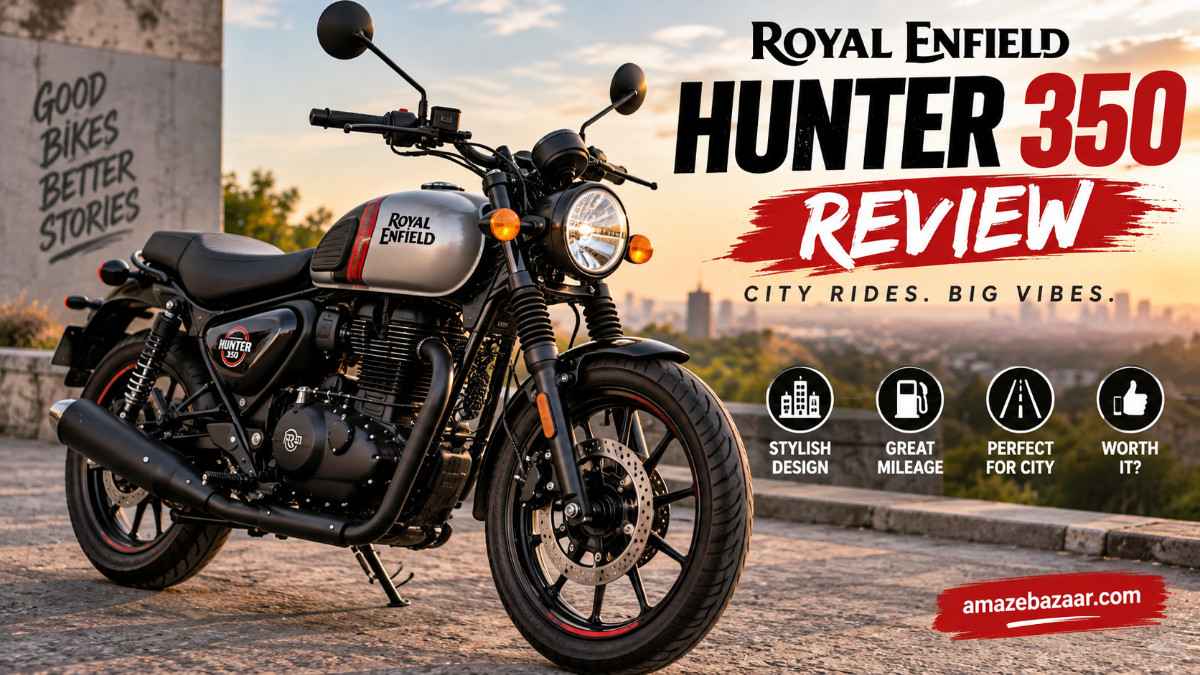
If you’ve been scrolling through bike forums or standing outside a Royal Enfield showroom trying to decide between a Classic and something a little more “city-friendly,” chances are the Hunter 350 has already caught your eye. It’s smaller, lighter, cheaper, and honestly, a lot more fun to ride in traffic than most other Royal Enfields.
I’ve spent time riding, reading up on, and comparing this bike against its rivals, and in this review, I’ll break down exactly what it’s like to live with the Hunter 350 — the good, the not-so-good, and whether it’s actually worth your money in 2026.
What Exactly Is the Royal Enfield Hunter 350?
The Hunter 350 is Royal Enfield’s answer to riders who love the brand’s classic thump but don’t want a heavy, long-wheelbase cruiser for daily commuting. It’s built on the same modern J-platform as the Meteor 350 and Classic 350, but everything about it — the frame, the wheelbase, the weight — has been shrunk down to make it nimble.
Think of it as the Royal Enfield you’d actually want to squeeze through Monday morning traffic on, not just take out for weekend highway runs.
Design and Looks
This is where the Hunter really works its charm. It has that round headlamp, teardrop-shaped fuel tank, and single-piece seat that scream “classic Royal Enfield,” but the proportions are tighter and more youthful. It doesn’t feel like you’re riding your dad’s bike — it feels like something built for someone starting out on two wheels but who still wants character, not just plastic and stickers.
The Hunter comes in three trims — Retro, Metro, and Metro Rebel — each with its own color schemes, ranging from muted factory tones to bolder rebel-inspired shades. There’s also now a Base Premium variant with alloy wheels replacing the earlier spoked rims on the entry trim, plus a semi-digital instrument cluster and a slightly sportier grab rail.
Engine and Performance
Under the tank sits the familiar 349cc single-cylinder, air-cooled engine, making around 20.2 PS and 27 Nm of torque, paired with a 5-speed gearbox. These numbers won’t blow your mind on paper, but that’s not really the point of this bike.
What surprises most riders is how usable the power delivery is. There’s a nice thump at low revs, decent pull in the mid-range for overtakes, and it settles into a comfortable cruising speed without feeling stressed. It’s not a highway missile, but for city rides and weekend getaways, it does the job without drama.
Claimed mileage sits around 36 kmpl, which is respectable for a bike this size and genuinely achievable if you’re not constantly wringing the throttle.
Ride Quality and Handling
This, for me, is the Hunter’s biggest strength. At around 181 kg, it’s the lightest bike in Royal Enfield’s current lineup, and you feel that the moment you take it off the stand. It’s flickable, easy to filter through traffic, and doesn’t demand much effort at low speeds — something that can’t be said for most other Royal Enfields.
The suspension setup (41mm telescopic forks up front, dual shocks with adjustable preload at the back) is tuned more toward comfort than sport, though some riders do find it a touch stiff over sharp bumps and broken roads. Braking is handled well by a 300mm front disc and 270mm rear disc, and ABS comes as standard, which is a nice safety net for new riders.
Comfort and Ergonomics
The riding position is upright and relaxed — nothing about it feels aggressive or tiring, even after a couple of hours in the saddle. The seat is reasonably cushioned, though taller riders might want a bit more legroom on longer trips. It’s really built with city and short-distance touring in mind, not cross-country expeditions.
Features
You won’t find touchscreen navigation or ride modes here — the Hunter keeps things simple. The higher variants get a semi-digital instrument cluster, USB charging, and a Tripper navigation pod (on some trims), while the base variant is refreshingly no-frills. Some riders will miss the extra tech; others will appreciate that Royal Enfield kept the focus on the riding experience instead of piling on gadgets.
Price: Is It Worth the Money?
As of the 2026 lineup, the Hunter 350 starts at around ₹1.50 lakh (ex-showroom) for the base trim, going up to roughly ₹1.80 lakh for the fully-loaded Metro Rebel variant, depending on your city and the color you pick. That puts it right in the sweet spot between budget commuters and full-size cruisers — you’re paying a premium over a regular 150cc bike, but you’re getting genuine Royal Enfield character, build quality, and resale value in return.
Compared to rivals like the TVS Ronin or the Honda CB350, the Hunter holds its own nicely on price while still feeling like the more “special” bike to own.
Pros and Cons at a Glance
What I liked:
- Lightest and easiest-to-ride Royal Enfield yet
- Classic styling in a compact, everyday-friendly package
- Comfortable, upright riding posture
- ABS as standard, decent braking
- Good fuel efficiency for the segment
- Attractive pricing for the brand and build quality on offer
What could be better:
- Suspension feels a bit stiff on rough roads
- Clutch pull can feel heavy after a long ride
- Not the fastest option if you’re chasing highway performance
- Fewer tech features compared to some rivals
Who Should Buy the Hunter 350?
If you’re a first-time Royal Enfield buyer, someone upgrading from a 150cc commuter, or simply someone who wants a stylish, easy-to-manage bike for daily rides without giving up that unmistakable RE character — the Hunter 350 makes a lot of sense. It’s not trying to be a tourer or a performance machine, and that’s exactly why it works so well at what it’s actually meant for.
If you’re after long highway trips, heavy touring, or serious power, you might want to look at the Meteor 350 or Classic 350 instead. But for city life and weekend rides with friends, the Hunter is hard to beat.
Royal Enfield Hunter 350 Engine Specifications
| Specification | Details |
|---|---|
| Engine Type | Single-cylinder, 4-stroke, air-oil cooled, SOHC |
| Engine Displacement | 349 cc |
| Maximum Power | 20.2 bhp (20.4 PS) @ 6,100 rpm |
| Maximum Torque | 27 Nm @ 4,000 rpm |
| Fuel System | Electronic Fuel Injection (EFI) |
| Cooling System | Air-Oil Cooled |
| Compression Ratio | 9.5:1 |
| Bore × Stroke | 72 mm × 85.8 mm |
| Valves | 2-Valve |
| Ignition | Electronic Ignition |
| Starting System | Electric Start |
| Transmission | 5-Speed Manual |
| Clutch | Wet Multi-Plate Assist & Slip Clutch |
| Final Drive | Chain Drive |
| Fuel Type | Petrol |
| Emission Standard | OBD-2B / BS6 Phase 2 (India) |
Engine Performance Highlights
- 349cc J-series engine shared with the Classic 350 and Meteor 350.
- Smooth and refined performance with reduced vibrations.
- Strong low-end and mid-range torque, making city riding effortless.
- Comfortable cruising speed of 80–100 km/h.
- Top speed of approximately 114 km/h (varies by rider and conditions).
- Real-world fuel efficiency typically ranges from 30–36 km/l, depending on riding style and traffic.
- Best suited for daily commuting, weekend rides, and short highway trips rather than aggressive high-speed touring.
Final Verdict
The Royal Enfield Hunter 350 does something a lot of manufacturers struggle with — it makes a heritage brand feel approachable again. It’s light, easy to ride, good-looking, and doesn’t ask you to compromise much for the price. A few rough edges around suspension and features keep it from being perfect, but overall, it’s one of the most sensible and enjoyable bikes in Royal Enfield’s current lineup.
If you’ve been on the fence about your first Royal Enfield, the Hunter 350 is probably the friendliest place to start.
Frequently Asked Questions
Q: What is the mileage of the Royal Enfield Hunter 350? It offers a claimed fuel efficiency of around 36 kmpl, which most riders find realistic in everyday use.
Q: Is the Hunter 350 good for daily commuting? Yes. Its light weight, upright riding position, and manageable size make it one of the most commuter-friendly Royal Enfields available.
Q: What is the price of the Royal Enfield Hunter 350? Prices start at roughly ₹1.50 lakh (ex-showroom) for the base variant and go up to around ₹1.80 lakh for the top Metro Rebel trim, depending on location and color.
Q: Does the Hunter 350 have ABS? Yes, ABS comes as standard across variants for added safety.
Q: Is the Hunter 350 good for highway riding? It can handle highway speeds comfortably for moderate distances, but it’s better suited to city and short-trip riding than long-distance touring.