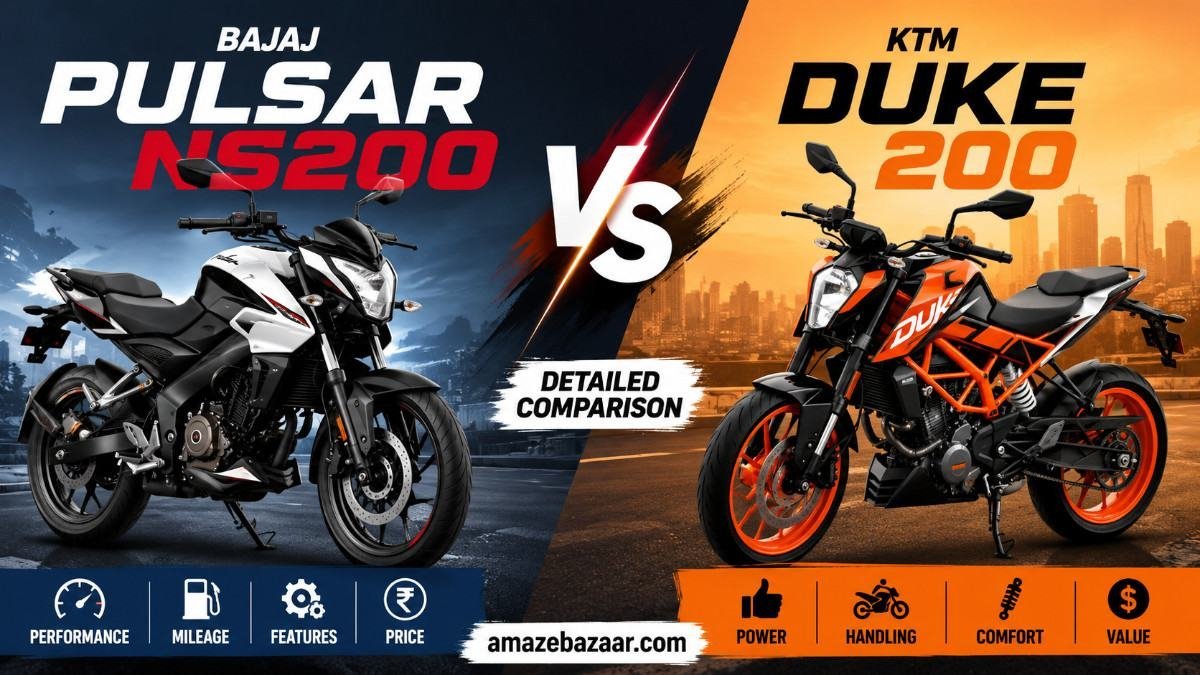
If you’re shopping for a quick, affordable naked motorcycle in India, chances are your shortlist has narrowed down to two names: the Bajaj Pulsar NS200 and the KTM Duke 200. Both share a common DNA — literally, since Bajaj and KTM co-developed these platforms years ago — but they’ve grown into very different machines with very different price tags.
So which one actually deserves your hard-earned money? Let’s break it down feature by feature, so you can decide with confidence instead of guesswork.
Quick Comparison Table
| Spec | Bajaj Pulsar NS200 | KTM Duke 200 |
|---|---|---|
| Engine | 199.5cc, liquid-cooled, single-cylinder | 199.5cc, liquid-cooled, single-cylinder |
| Power | ~24.5 PS @ 9,750 rpm | ~24.7–25.4 PS |
| Torque | ~18.74 Nm @ 8,000 rpm | ~19.3 Nm |
| Gearbox | 6-speed | 6-speed |
| Kerb Weight | ~145 kg | ~159 kg |
| Front Suspension | Telescopic / USD (variant dependent) | WP Apex USD forks |
| ABS | Single/Dual-channel (variant dependent) | Dual-channel |
| Top Speed | ~136 km/h | ~140 km/h |
| Mileage (ARAI) | ~40 kmpl | ~35 kmpl |
| Ex-showroom Price | Approx. ₹1.38–1.60 lakh | Approx. ₹2.04–2.06 lakh |
Prices and specs vary by city, variant, and dealership offers — always confirm the latest ex-showroom price before booking.
Engine and Performance
Both bikes share an almost identical 199.5cc liquid-cooled single-cylinder engine — no surprise, given their shared engineering roots. On paper, the numbers look close: the Pulsar NS200 makes around 24.5 PS, while the Duke 200 edges ahead with roughly 25 PS and a touch more torque.
In the real world, though, the Duke 200 feels noticeably peppier. It’s lighter, revs more freely, and has a more aggressive throttle response that rewards spirited riding. The Pulsar NS200, on the other hand, feels a little flat at low revs and prefers to be worked hard past the 6,000 rpm mark before it really comes alive — great for highway overtakes, less ideal for stop-start city traffic.
Verdict: KTM Duke 200 wins on outright performance feel; Pulsar NS200 is more usable in everyday traffic once you’re used to its power delivery.
Handling and Ride Quality
This is where the Duke 200 truly separates itself. With a kerb weight of around 159 kg against a shorter wheelbase, WP Apex suspension, and a trellis frame borrowed straight from KTM’s bigger Dukes, it’s engineered to feel like a “sharp knife cutting through traffic.” Corner confidence, quick direction changes, and outright agility are the Duke’s calling cards.
The Pulsar NS200 isn’t far behind, though. Its perimeter frame and monoshock rear setup make it a genuinely capable handler for the price, and the newer variants with upside-down forks and dual-channel ABS have closed the gap considerably. It’s slightly heavier but still nimble enough for daily commuting and the occasional weekend twisty road.
Verdict: Duke 200 for outright cornering thrills; NS200 for a comfortable middle ground between sportiness and everyday practicality.
Features and Technology
The KTM Duke 200 punches well above its price bracket here. It gets a 5-inch full-color TFT display (shared with the bigger 390 Duke), turn-by-turn navigation, Bluetooth connectivity, call/SMS alerts, and a genuinely premium fit and finish.
The Pulsar NS200 has caught up in recent updates too, now offering a Bluetooth-enabled digital console with navigation and ABS ride modes, plus all-LED lighting. It’s a big step up from older Pulsar generations, though it still doesn’t quite match the Duke’s TFT screen for sheer visual appeal.
Verdict: Duke 200 offers a more premium, tech-forward cockpit; NS200 delivers most of the essentials at a fraction of the cost.
Mileage and Running Costs
Fuel efficiency clearly favors the Pulsar. The NS200 returns an ARAI-claimed mileage in the 36–40 kmpl range, while the Duke 200 sits closer to 35 kmpl. Over a year of daily riding, that difference adds up — especially for riders who use their bike as a primary commuter rather than a weekend toy.
Maintenance and spare parts also tend to be cheaper and more widely available for the Pulsar, thanks to Bajaj’s extensive service network across India. KTM service centers, while improving, are still comparatively fewer in smaller towns.
Verdict: Pulsar NS200 is the clear winner for long-term running and ownership costs.
Price: The Real Deciding Factor
Here’s where the comparison often ends before it even begins for many buyers. The Bajaj Pulsar NS200 starts at roughly ₹1.38 lakh ex-showroom and tops out around ₹1.60 lakh for the fully-loaded dual-channel ABS variant.
The KTM Duke 200, meanwhile, starts at approximately ₹2.04 lakh ex-showroom — a premium of well over ₹50,000–₹65,000 depending on the city and ongoing offers.
That’s a significant gap for two bikes with such similar core hardware, and it’s the single biggest factor pushing budget-conscious buyers toward the Pulsar.
Which One Should You Buy?
Choose the Bajaj Pulsar NS200 if:
- You want the best value-for-money 200cc streetfighter
- Daily commuting and fuel efficiency matter more than outright thrills
- You prefer Bajaj’s wider and cheaper service network
- Your budget is tighter and every rupee counts
Choose the KTM Duke 200 if:
- You want sharper handling and a more premium riding experience
- Weekend performance riding and corner-carving matter to you
- You don’t mind paying extra for a better tech package and brand badge
- You’re comfortable with slightly higher running and maintenance costs
Final Verdict
There’s no universally “better” bike here — only a better bike for you. The Bajaj Pulsar NS200 is the smarter all-round choice for most Indian riders: cheaper to buy, cheaper to run, and easier to live with day to day. The KTM Duke 200 is for riders who see their motorcycle as more than transportation — who want that extra edge in handling, performance, and street presence, and are willing to pay a real premium for it.
Test ride both if you can. Numbers on a spec sheet only tell half the story; the other half is how a bike feels under you on your own roads.
Frequently Asked Questions
Is KTM Duke 200 faster than Pulsar NS200? Yes, the Duke 200 has a slightly higher top speed (around 140 km/h vs 136 km/h) and feels quicker off the line due to its lower kerb weight and sharper throttle response.
Which bike gives better mileage, NS200 or Duke 200? The Bajaj Pulsar NS200 generally returns better fuel efficiency, with ARAI figures around 36-40 kmpl compared to the Duke 200’s roughly 35 kmpl.
Is the KTM Duke 200 worth the extra money over the Pulsar NS200? It depends on your priorities. If sharper handling, a premium TFT display, and stronger brand appeal matter to you, the extra cost can be justified. If you want maximum value and lower running costs, the NS200 makes more financial sense.
Which bike has better resale value, Pulsar NS200 or Duke 200? Bajaj Pulsar models typically hold resale value well due to high demand and easy availability of spare parts, while KTM’s resale value can vary more by region and service network availability.
Disclaimer: Prices and specifications mentioned are approximate and subject to change based on city, variant, and ongoing manufacturer offers. Please check with your nearest Bajaj or KTM dealership for the latest on-road price before making a purchase decision.