
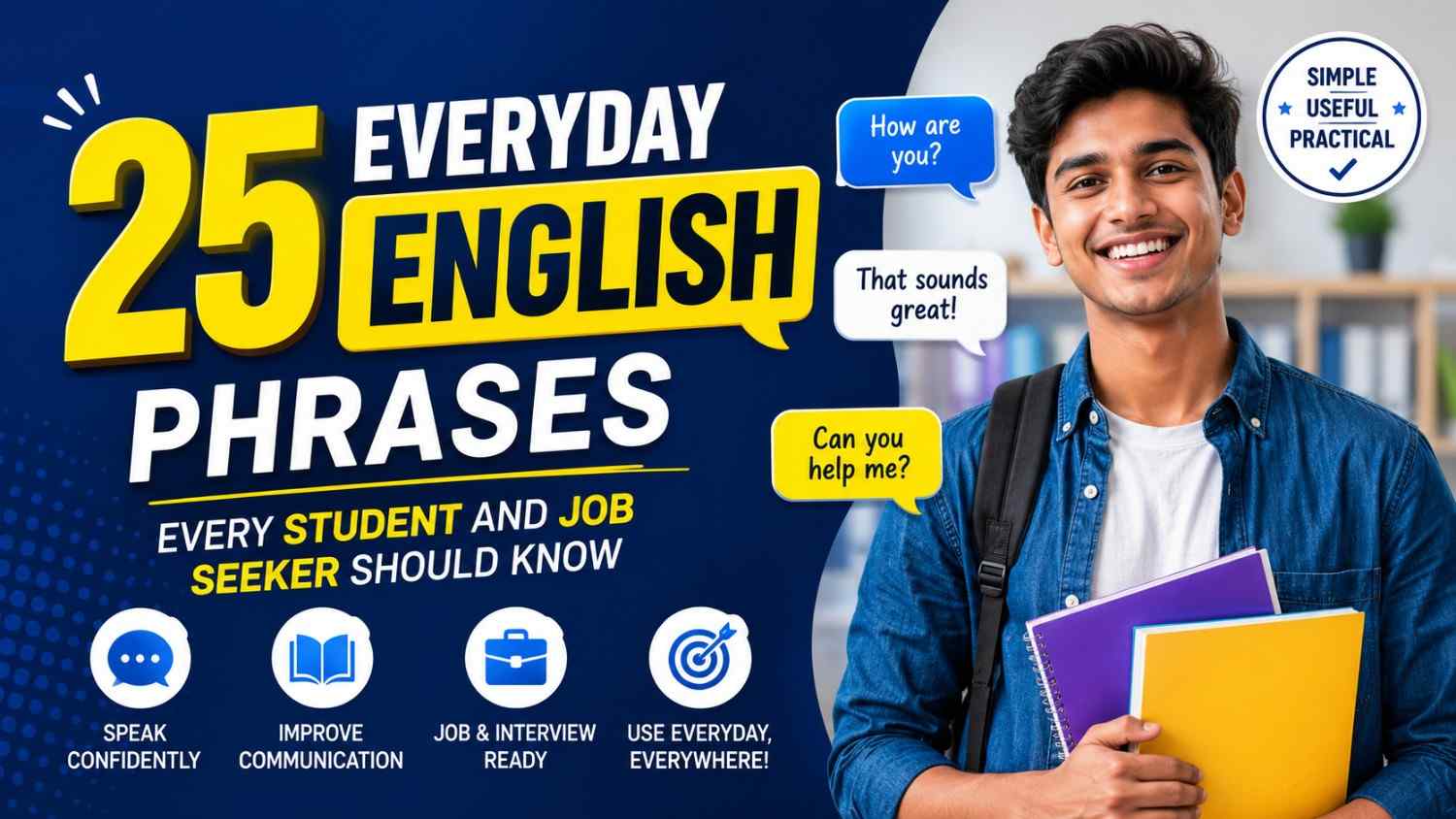
If you’ve ever understood English but struggled to speak it confidently, you’re not alone.
Many students and job seekers know grammar rules, but when it’s time to speak in a classroom, interview, or office, they suddenly forget what to say.
The good news? You don’t need thousands of difficult words.
Learning a few common English phrases can make your conversations sound more natural and confident.
In this article, you’ll discover 25 practical English phrases that native speakers and fluent English learners use every day. Each phrase comes with a simple explanation and an easy example.
Let’s begin!
1. How’s it going?
Meaning: How are you?
Example:
“Hey Rahul, how’s it going?”
2. Nice to meet you
Meaning: Used when meeting someone for the first time.
Example:
“Nice to meet you. I’m Suman.”
3. Could you help me?
Meaning: A polite way to ask for help.
Example:
“Could you help me find the interview room?”
4. I appreciate it
Meaning: Thank you very much.
Example:
“I appreciate your support.”
5. That’s a good idea
Meaning: Showing agreement.
Example:
“Let’s practice every day.”
“That’s a good idea.”
6. I’m not sure
Meaning: You don’t know the answer.
Example:
“I’m not sure about the meeting time.”
7. Let me think
Meaning: Give me a moment to think.
Example:
“Let me think before I answer.”
8. It depends
Meaning: The answer changes according to the situation.
Example:
“Will you work from home?”
“It depends on the company.”
9. No problem
Meaning: You’re welcome.
Example:
“Thanks for helping me.”
“No problem.”
10. Excuse me
Meaning: To politely get someone’s attention.
Example:
“Excuse me, where is the library?”
11. I’m looking for…
Meaning: Searching for something.
Example:
“I’m looking for an internship.”
12. I understand
Meaning: You understand what someone said.
Example:
“Yes, I understand the instructions.”
13. Could you repeat that?
Meaning: Ask someone to say something again.
Example:
“Sorry, could you repeat that?”
14. That’s interesting
Meaning: Show interest.
Example:
“That’s interesting! Tell me more.”
15. Sounds good
Meaning: Agree with a plan.
Example:
“Let’s study together tomorrow.”
“Sounds good!”
16. I agree
Meaning: You share the same opinion.
Example:
“I agree with your point.”
17. I don’t think so
Meaning: Polite disagreement.
Example:
“Will it rain today?”
“I don’t think so.”
18. What do you mean?
Meaning: Ask for clarification.
Example:
“What do you mean by flexible timing?”
19. I’m ready
Meaning: Prepared to start.
Example:
“I’m ready for the interview.”
20. Take your time
Meaning: No need to hurry.
Example:
“Take your time while answering.”
21. That’s okay
Meaning: It’s fine.
Example:
“Sorry I’m late.”
“That’s okay.”
22. Keep it up
Meaning: Continue doing well.
Example:
“Your English is improving. Keep it up!”
23. Don’t worry
Meaning: Everything will be okay.
Example:
“Don’t worry. You’ll do well.”
24. I’m excited
Meaning: Feeling happy and eager.
Example:
“I’m excited about my first job interview.”
25. See you soon
Meaning: Goodbye for now.
Example:
“See you soon. Have a great day!”
How to Remember These Phrases Faster
Learning phrases is much easier than memorizing individual words.
Here are a few tips:
- Speak five phrases aloud every morning.
- Use them in real conversations.
- Watch English videos and notice when speakers use them.
- Record yourself speaking.
- Practice with a friend or AI every day.
- Don’t worry about making mistakes.
Consistency matters more than perfection.
Why These Phrases Matter
Whether you’re preparing for:
- School or college presentations
- Campus placements
- Job interviews
- Customer service jobs
- Office conversations
- Daily English speaking
These phrases will make your English sound more natural and confident.
Fluency doesn’t come from knowing difficult vocabulary. It comes from using simple English comfortably every day.
Final Thoughts
Improving spoken English isn’t about learning hundreds of grammar rules overnight. It’s about using the right phrases regularly until they become a habit.
Start with these 25 everyday English expressions. Practice a few each day, use them whenever you get the chance, and you’ll notice your confidence growing week by week.
Remember, every fluent English speaker was once a beginner. Keep practicing, stay patient, and don’t be afraid to speak.
Your English journey starts with one conversation at a time.
Frequently Asked Questions (FAQs)
Which English phrases should beginners learn first?
Start with greetings, polite expressions, asking for help, and common responses like “Thank you,” “Excuse me,” “No problem,” and “Sounds good.”
How many English phrases should I learn every day?
Learning and practicing 3–5 new phrases daily is enough to build long-term fluency.
Are these phrases useful for job interviews?
Yes. Many of these phrases help you communicate politely and confidently during interviews and workplace conversations.
How can I improve spoken English faster?
Practice speaking every day, listen to English conversations, read aloud, and use common phrases in real-life situations instead of only studying grammar.




Discussion