
Have you ever finished an English movie and thought, “I’m learning English!”?
You’re not alone.
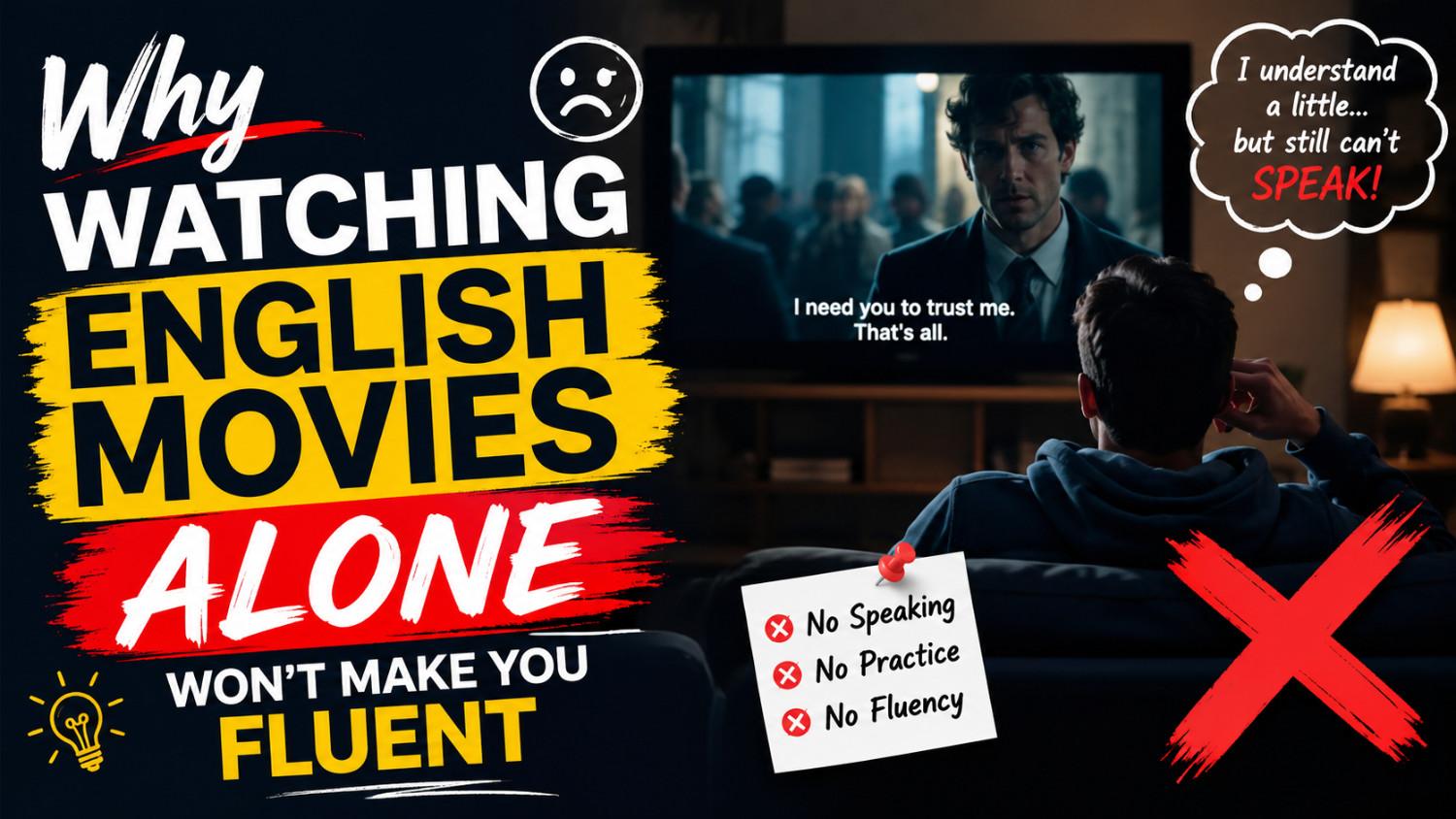
Millions of English learners believe that watching Hollywood movies or Netflix series is the secret to speaking fluent English. While movies are entertaining and can improve your listening skills, the truth is simple:
Watching English movies alone will never make you fluent.
If it did, millions of movie lovers around the world would already be speaking English confidently.
So why doesn’t it work? And what should you do instead?
Let’s find out.
Movies Teach You to Understand, Not to Speak
Think about how you learned your first language.
Did you become fluent just by watching people talk?
No.
You listened, copied, made mistakes, spoke every day, and received feedback.
Learning English works the same way.
Watching movies only trains your brain to recognize words and sentences. It doesn’t train your mouth to produce them naturally.
Speaking is a skill.
And like every skill, it improves only through practice.
Passive Learning vs Active Learning
Watching movies is a form of passive learning.
You’re receiving information, but you’re not using it.
Imagine watching cooking videos every day.
Will you become a great chef?
Probably not.
You’ll only become a better cook when you actually start cooking.
English speaking follows the same rule.
You need active learning:
- Speaking aloud
- Repeating sentences
- Answering questions
- Having conversations
- Thinking in English
Movies Are Full of Unnatural Conversations
Movies are written to entertain.
Real life is different.
Movie characters may:
- Speak very fast
- Use slang
- Use regional accents
- Say dramatic lines
- Use expressions people rarely use in daily life
For beginners, this can be confusing.
Instead of learning practical English, many learners end up memorizing dialogues they’ll never use.
Understanding Isn’t the Same as Fluency
Many learners say:
“I understand English, but I can’t speak.”
This happens because your brain has two different skills:
- Input (Listening & Reading)
- Output (Speaking & Writing)
Watching movies improves your input.
Speaking practice improves your output.
You need both.
Why You Forget Words So Quickly
Have you ever learned a new word from a movie and forgotten it the next day?
That’s completely normal.
Your brain remembers information better when you actively use it.
Instead of only hearing a new word, try this:
- Write it down.
- Say it aloud five times.
- Create your own sentence.
- Use it in a conversation the same day.
Now your brain has a reason to remember it.
The Biggest Mistake English Learners Make
Many people think:
“I’ll start speaking after I become fluent.”
But fluency doesn’t come first.
Speaking comes first.
Fluency is the result of speaking consistently.
Even native children make grammar mistakes while learning.
Don’t wait for perfect English.
Start speaking with imperfect English.
How to Use Movies the Right Way
Movies are still an excellent learning tool—if you use them correctly.
Here’s a smarter method.
Step 1: Choose Easy Content
Start with simple movies or TV shows.
Avoid complicated action films with fast dialogue.
Animated movies and family shows are great choices.
Step 2: Turn On English Subtitles
Avoid subtitles in your native language.
English subtitles help connect spoken words with written words.
Step 3: Pause Frequently
Don’t watch the whole movie in one go.
Pause after interesting sentences.
Repeat them aloud.
Copy the actor’s pronunciation and emotion.
Step 4: Shadow the Dialogue
This technique is called shadowing.
Listen to one sentence.
Pause.
Repeat exactly like the speaker.
Focus on:
- Pronunciation
- Speed
- Intonation
- Emotion
This is one of the fastest ways to improve speaking confidence.
Step 5: Speak About the Movie
After watching, summarize the story in English.
For example:
- What happened?
- Who was your favorite character?
- What did you learn?
Speaking about what you watched strengthens memory and fluency.
What Actually Makes You Fluent?
Real fluency comes from combining several habits.
Every day, try to:
- Speak English for 15–30 minutes.
- Read something in English.
- Listen to English audio.
- Learn 5–10 new words.
- Use those words in sentences.
- Record yourself speaking.
- Talk with a friend or language partner.
Consistency beats perfection.
A Daily 30-Minute Practice Plan
If you’re busy, here’s a simple routine.
10 Minutes: Watch an English video or movie clip.
5 Minutes: Write down new words.
10 Minutes: Repeat the dialogue aloud.
5 Minutes: Speak about what you watched without looking at notes.
Do this every day for three months.
You’ll notice a huge improvement.
Final Thoughts
Watching English movies is fun, motivating, and useful—but it’s only one piece of the puzzle.
Think of movies as a supplement, not the entire learning method.
If your goal is to speak English confidently, you must also practice speaking, thinking, reading, and writing every day.
Remember:
Don’t just watch English. Live it. Speak it. Practice it.
That’s the real path to fluency.
Frequently Asked Questions
Can I become fluent just by watching English movies?
No. Movies improve listening and vocabulary, but speaking fluently requires regular conversation and practice.
Should I watch movies with subtitles?
Yes. Use English subtitles whenever possible. Avoid subtitles in your native language if your goal is to improve English.
How much should I practice speaking every day?
Even 20–30 minutes of speaking practice daily can make a noticeable difference over time.
Are movies good for beginners?
Yes, but choose easy movies or TV shows with clear pronunciation and simple vocabulary.
Conclusion
Don’t stop watching English movies—but don’t stop there either.
Every conversation you have, every sentence you speak, and every mistake you make brings you one step closer to fluency.
The secret isn’t watching more.
The secret is speaking more.