Have you ever spoken English confidently, only to realize later that the sentence sounded strange?
You’re not alone.
Millions of English learners make the same mistakes every day—not because they’re bad at English, but because they directly translate sentences from their native language.
The good news?
Most of these mistakes are easy to fix.
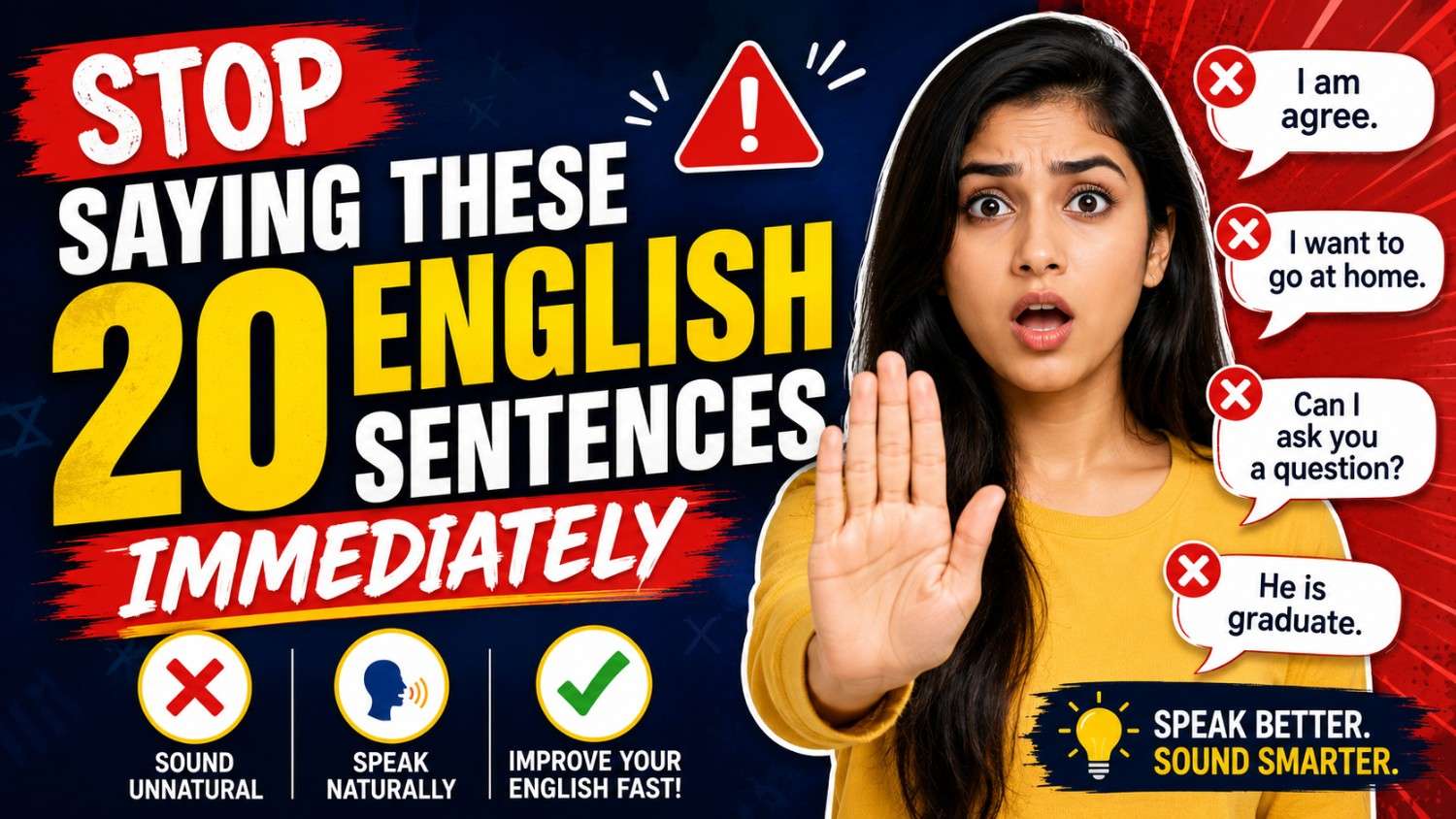
In this guide, you’ll discover 20 common English sentences you should stop saying immediately and learn the natural alternatives that fluent speakers actually use.
These small changes can instantly make your English sound more confident, natural, and professional.
1. ❌ I am agree.
✅ I agree.
The verb agree doesn’t need “am.”
2. ❌ He is graduate.
✅ He is a graduate.
✅ He graduated.
Both are correct depending on the situation.
3. ❌ I want to go at home.
✅ I want to go home.
Never use at before home in this sentence.
4. ❌ Discuss about the problem.
✅ Discuss the problem.
The word discuss already includes the meaning of “about.”
5. ❌ Return back.
✅ Return.
✅ Come back.
Using both words together is unnecessary.
6. ❌ Repeat again.
✅ Repeat.
“Repeat” already means doing something again.
7. ❌ Open the light.
✅ Turn on the light.
We don’t “open” lights in English.
8. ❌ Close the light.
✅ Turn off the light.
This is one of the most common mistakes among learners.
9. ❌ My English is very poor.
✅ I’m still improving my English.
This sounds much more positive and confident.
10. ❌ I have one doubt.
✅ I have a question.
In everyday English, native speakers usually say “question.”
11. ❌ Give me one pen.
✅ Give me a pen.
Use a unless you’re referring to a specific number.
12. ❌ I didn’t knew.
✅ I didn’t know.
After did, always use the base form of the verb.
13. ❌ She don’t like coffee.
✅ She doesn’t like coffee.
Remember: He, She, It + doesn’t.
14. ❌ More better.
✅ Better.
“Better” is already comparative.
15. ❌ Can able to help me?
✅ Can you help me?
✅ Are you able to help me?
Never combine can and able to together.
16. ❌ I am having two brothers.
✅ I have two brothers.
Use have, not am having, for family relationships.
17. ❌ Where do you stay?
✅ Where do you live?
“Stay” usually refers to temporary accommodation.
18. ❌ Myself Rahul.
✅ I’m Rahul.
✅ My name is Rahul.
This is much more natural.
19. ❌ He gave me an advice.
✅ He gave me some advice.
✅ He gave me a piece of advice.
“Advice” is an uncountable noun.
20. ❌ I am preparing for interview.
✅ I am preparing for an interview.
Don’t forget the article.
Why Do These Mistakes Happen?
Most English learners don’t make these mistakes because they lack intelligence.
They happen because we often translate directly from our native language.
Every language has its own sentence structure.
Instead of translating word by word, try learning complete English phrases.
That’s how fluent speakers think and communicate naturally.
How to Stop Making These Mistakes
The fastest way to improve isn’t memorizing hundreds of grammar rules.
Instead, follow these simple habits:
Read English articles every day.
Listen carefully to native speakers.
Practice speaking aloud.
Record your voice.
Notice how fluent speakers form sentences.
Replace incorrect habits with correct ones through daily repetition.
Over time, these new sentence patterns become automatic.
Practice Challenge
Read each incorrect sentence.
Say the correct version aloud three times.
Use it in your own example.
Repeat the exercise every day for one week.
You’ll be surprised how quickly these mistakes disappear from your speech.
Final Thoughts
Perfect English isn’t about using difficult vocabulary.
It’s about using simple sentences correctly.
Every small improvement makes your communication clearer and more professional.
Start by eliminating these 20 common mistakes.
Your English will immediately sound more natural, whether you’re speaking in a classroom, attending a job interview, or chatting with friends.
Remember, fluency isn’t built by learning more words.
It’s built by using the right words in the right way.
So the next time you’re about to say one of these incorrect sentences, pause for a second—and choose the natural version instead.