I still remember the exact moment I almost bought the wrong first bike. I was standing in a dealership, staring at a gorgeous 650cc sportbike that was way more machine than I had any business owning, and a salesman who clearly wanted his commission was telling me it was “totally fine for a beginner.” It wasn’t. I’m glad an older rider standing nearby pulled me aside and talked me out of it.
That conversation probably saved me a trip to the ER, or at least a very expensive insurance claim.
If you’re shopping for your first motorcycle right now, you’re in a much better spot than I was. There’s a genuinely great crop of beginner-friendly bikes on the market in 2026, and you don’t need to spend a fortune to get one that’s reliable, fun, and — most importantly — won’t try to kill you the first time you grab too much throttle. Here’s everything I’d tell a friend who asked me where to start.
Why $5,000 Is the Sweet Spot for a First Bike
Before we get to the actual bikes, let’s talk about why this budget makes sense in the first place.
New riders drop their motorcycles. It’s not a matter of if, it’s when. Slow-speed tip-overs in parking lots, missed shifts at a stop sign, misjudged U-turns — it happens to almost everybody in the first year, including riders who go on to become genuinely skilled. If your first bike costs $15,000, every one of those mistakes stings. If it costs $4,500, a scuffed mirror or a bent lever is an annoyance, not a heartbreak.
There’s also a practical money argument. Staying under $5,000 on the bike itself leaves room in your budget for the stuff that actually keeps you safe and legal: a good helmet, a proper jacket, gloves, boots, insurance, registration, and maybe a riding course. New riders who blow their entire budget on the bike often end up cutting corners on gear, and that’s backwards.
What Actually Makes a Motorcycle “Beginner-Friendly”
A lot of bikes get marketed as beginner bikes just because they’re small. That’s not the whole story. When you’re evaluating a first motorcycle, pay attention to:
- Manageable power delivery. You want an engine that builds power smoothly, not one that surges the instant you touch the throttle.
- Low seat height and light weight. Being able to flat-foot the bike at a stop light does more for your confidence than almost anything else.
- Predictable handling. Neutral, stable steering beats “sporty” every time when you’re still learning.
- Cheap, simple maintenance. Air-cooled or simple liquid-cooled engines with widely available parts save you money and headaches.
- A forgiving clutch (or none at all). If manual shifting sounds intimidating, automatic and semi-automatic motorcycles have genuinely come a long way.
With that in mind, here’s where I’d actually point a new rider in 2026.
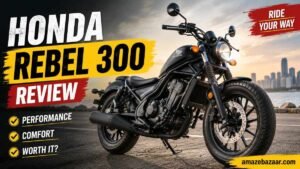
1. Honda Rebel 300 — The Bike That’s Impossible to Go Wrong With
The Rebel 300 shows up on basically every beginner list for a reason: it just works. It’s a cruiser, so the seat height is low and the riding position is relaxed, but it doesn’t feel sluggish the way a lot of cruisers do. The single-cylinder engine is smooth, the clutch is light, and Honda’s reliability reputation isn’t marketing fluff — these things run forever with basic maintenance.
If you want a bike you can learn on for a year, then either keep forever or sell easily when you’re ready to upgrade, this is it.
Best for: riders who want the safest possible bet and don’t care about chasing top speed.
2. Honda Grom — Tiny, Absurdly Fun, Genuinely Practical
Don’t let the size fool you. The Grom has a cult following, and it’s not just because it’s cute. It’s light enough that dropping it barely registers as a problem, cheap enough to insure that new riders sometimes forget they’re paying for insurance at all, and fuel-efficient enough that you’ll forget what a gas station even smells like.
It’s not going to keep up with highway traffic comfortably, so think of it as a city and neighborhood bike rather than a long-distance tourer. But for building raw riding skill — clutch control, braking, cornering — small bikes like this teach you more, faster, than anything with more horsepower ever will.
Best for: short commutes, city riding, and riders who want their first bike to be genuinely stress-free to own.
3. Royal Enfield Hunter 350 — Old-School Charm, New-Rider Manners
The Hunter 350 has quietly become one of the most talked-about beginner bikes in the last couple of years, and I get why. It has that classic, round-headlight motorcycle look that a lot of new riders actually want their first bike to have — instead of looking like a toy, it looks like a real motorcycle. Underneath that retro styling, though, is a genuinely torquey, low-stress single-cylinder engine that’s easy to ride smoothly from your very first ride.
It’s heavier than the Grom or the Rebel 300, so it’s worth sitting on one before you buy if you’re on the shorter or lighter side.
Best for: riders who want classic styling without sacrificing beginner-friendly manners.
4. Yamaha MT-03 — For the Rider Who Wants a Little More Edge
If a cruiser feels too laid-back for your taste, the MT-03 is where I’d point you next. It shares its 321cc liquid-cooled parallel-twin engine with Yamaha’s YZF-R3 sportbike, but it wears aggressive, angular naked-bike styling instead of full fairings. The result looks like it costs a lot more than it does.
It has more performance headroom than the bikes above, which is a double-edged sword — it’ll grow with you longer, but it also demands a bit more self-discipline early on. This is the one I’d recommend to a new rider who’s genuinely serious about progressing quickly and wants a bike that won’t feel outgrown in a year.
Best for: riders who want a naked-sportbike feel with room to grow into faster riding.
5. Yamaha V Star 250 — The Quiet, Reliable Workhorse
The V Star 250 has been around for decades, and it’s stuck around because it just does its job. It’s air-cooled, carbureted, and about as mechanically simple as a motorcycle gets — which is a feature, not a downside, for a first bike. Simple engines are cheap to maintain and easy to diagnose when something does go wrong.
It’s not flashy, and it won’t win any drag races, but it’s an honest, low-drama cruiser that a lot of long-time riders still keep around as a second bike for easy, relaxed rides.
Best for: riders who value low running costs and mechanical simplicity above all else.
6. Honda CB300R — The Naked Bike With Real Poise
The CB300R punches above its weight class. Its single-cylinder engine delivers smooth, predictable power, and the handling is noticeably sharper than a lot of other beginner bikes in this range, without becoming twitchy or nervous. It also just looks great — the kind of bike that doesn’t scream “starter motorcycle” the way some entry-level models do.
Best for: riders who want confident handling in a lightweight, stylish package.
What About Automatic Motorcycles?
If the idea of learning a clutch alongside everything else about riding sounds overwhelming, you’re not alone, and automatic motorcycles have become a genuinely solid option rather than an afterthought. Automatic and semi-automatic beginner bikes remove gear-shifting from the equation entirely, which lets you focus on balance, braking, and road awareness first.
They tend to appeal to commuters and returning riders as much as brand-new ones, since they offer more highway-friendly wheel sizes and a more traditional motorcycle feel than a scooter, while still keeping things simple. If you know clutch control is going to be your biggest hurdle, it’s worth test-riding one before committing to a manual bike out of habit.
New vs. Used: Which Should You Buy?
Here’s my honest take: buy used for your very first bike if you can find a clean one.
A well-maintained used bike in this price range, even from a small dealer or a careful private seller, often gets you a slightly bigger or nicer model than a brand-new budget bike would. And since you’re statistically likely to drop your first bike at least once, you’ll feel a lot better about a scratch on a $3,000 used Rebel than on a brand-new one you just rode off the lot.
If you do buy used, get it inspected before you hand over cash — a mechanic can usually check a small bike over for $50–$100, and it’s the cheapest insurance you’ll ever buy.
A Few Things Nobody Tells New Riders
- Take a riding course before you take a test ride. Most dealerships won’t hand you the keys anyway, but a proper safety course (many states subsidize them) will teach you fundamentals faster than trial and error ever will.
- Budget for gear like it’s part of the bike’s price, not an accessory. A helmet, jacket, gloves, and boots aren’t optional extras — treat them as part of your $5,000, not something you’ll “get around to.”
- Insurance is cheaper than you think on small bikes. This is one of the underrated perks of starting small.
- You will probably sell this bike within two years. That’s normal, and it’s fine. Most riders outgrow their first bike as their skills develop — buying used makes that transition much less painful financially.
Final Thoughts
There’s no single “best” beginner motorcycle under $5,000 — there’s the best one for you. If you want the safest, most forgiving option, the Honda Rebel 300 is genuinely hard to beat. If you want something you’ll never worry about, the Grom or the V Star 250 will treat you well. If you want a bike with a bit more attitude that’ll keep you challenged as you improve, look at the MT-03 or the CB300R.
Whatever you choose, the real secret to loving your first motorcycle isn’t the horsepower number or the styling — it’s picking something that lets you build confidence instead of fighting you every time you swing a leg over it. Get that part right, and you’ll remember your first bike fondly for the rest of your riding life, scratches and all.
Frequently Asked Questions
Is 300cc enough for a first motorcycle? For the vast majority of new riders, yes. A 250–350cc bike gives you enough power to comfortably handle city streets and even short highway stretches, while staying light and predictable enough to learn on safely.
Should I buy new or used as a beginner? Used is usually the smarter first move, since you’re likely to drop the bike at least once while learning. Just have any used bike inspected before you buy it.
Do I need a motorcycle license before buying? Requirements vary by state or country, but most places let you buy a bike before you’re licensed. Many new riders take a safety course first, which often satisfies the licensing test requirement too.
Are automatic motorcycles a good choice for beginners? Absolutely, especially if learning a clutch feels like the most intimidating part of riding. They let you focus on balance and road awareness before adding manual shifting to the mix.